A blueprint for onboarding new cybersecurity professionals
An efficient onboarding process gets cyber talent up to speed quickly, retains employees, and increases your security posture.


Table of Contents
Recruiting doesn’t end after a candidate accepts an offer, it simply moves into the next crucial stage: onboarding. An efficient onboarding process is necessary to retain top-quality talent, especially in an industry that severely lacks employees with experience.
The famous saying: “fail to prepare, prepare to fail” certainly rings true here. You want to set your new cyber team up for success, and an efficient onboarding process is the secret.
Why is onboarding important in cybersecurity?
Organizations with a strong onboarding process improve new hire retention by 82%, so there’s a lot to be said about taking the time to get it right.
In the cybersecurity industry, there’s little time to waste when it comes to getting new hires up to speed. Existing teams are already spread thin, with burnout rife. 83% of cybersecurity professionals admit that they or someone in their team have made errors that have led to a breach due to burnout.
An efficient onboarding program results in improved employee engagement, boosted retention rates, reduced chances of burnout, and less strain on senior employees.
CISOs can become advocates for solid onboarding programs, working closely with their HR team to effectively implement one.
Cybersecurity onboarding best practices
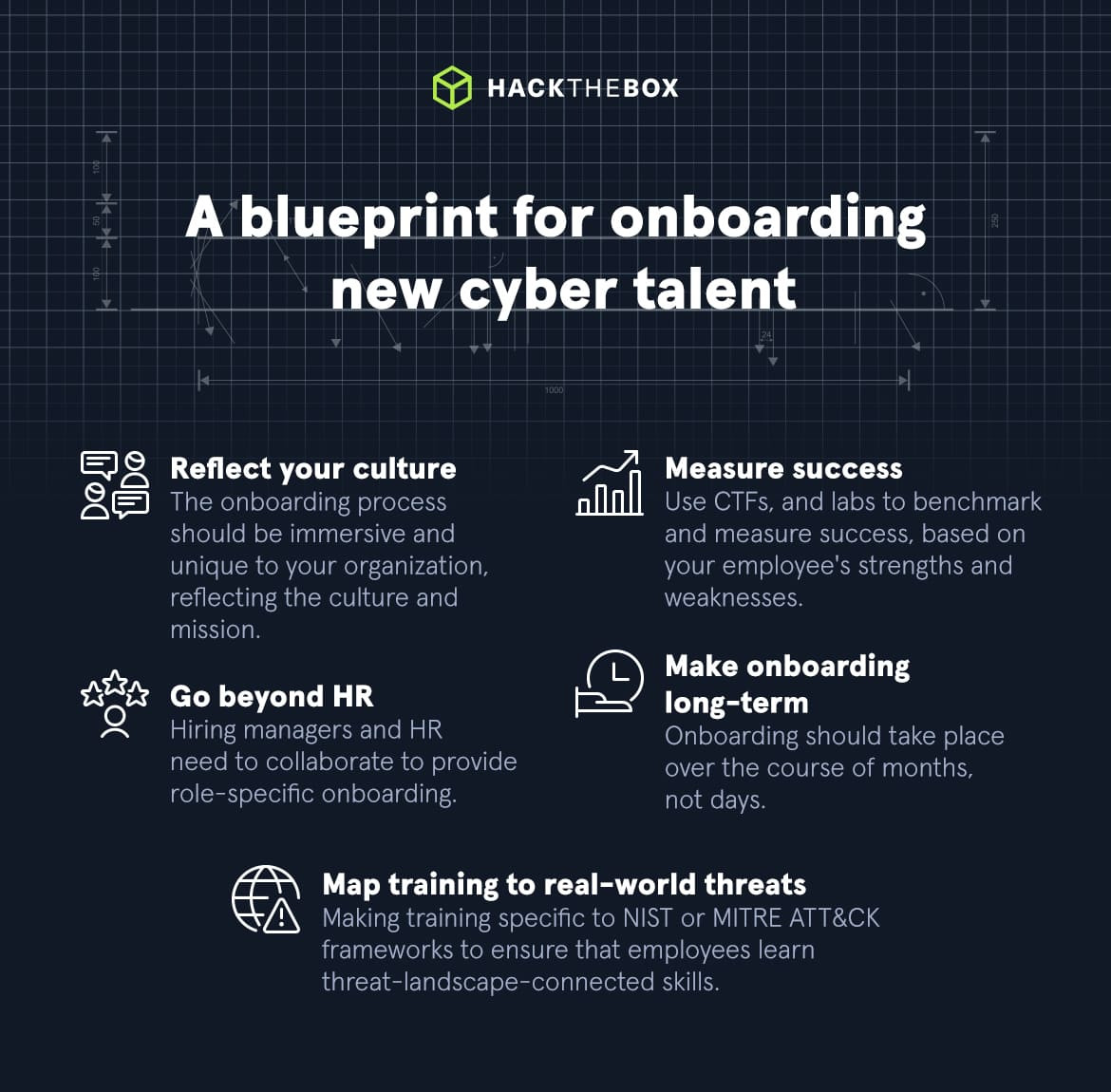
Onboarding is a broad, long-term process that should take place over months. If your onboarding process is quick, this flags that it isn’t in-depth enough.
Starting with HR, onboarding should reflect your company culture, vision, mission, and values. It should also include an introduction to the entire company structure and benefits.
Moving to a micro level, this is where managers take over and share specific information about the cybersecurity role, which we dive into below:
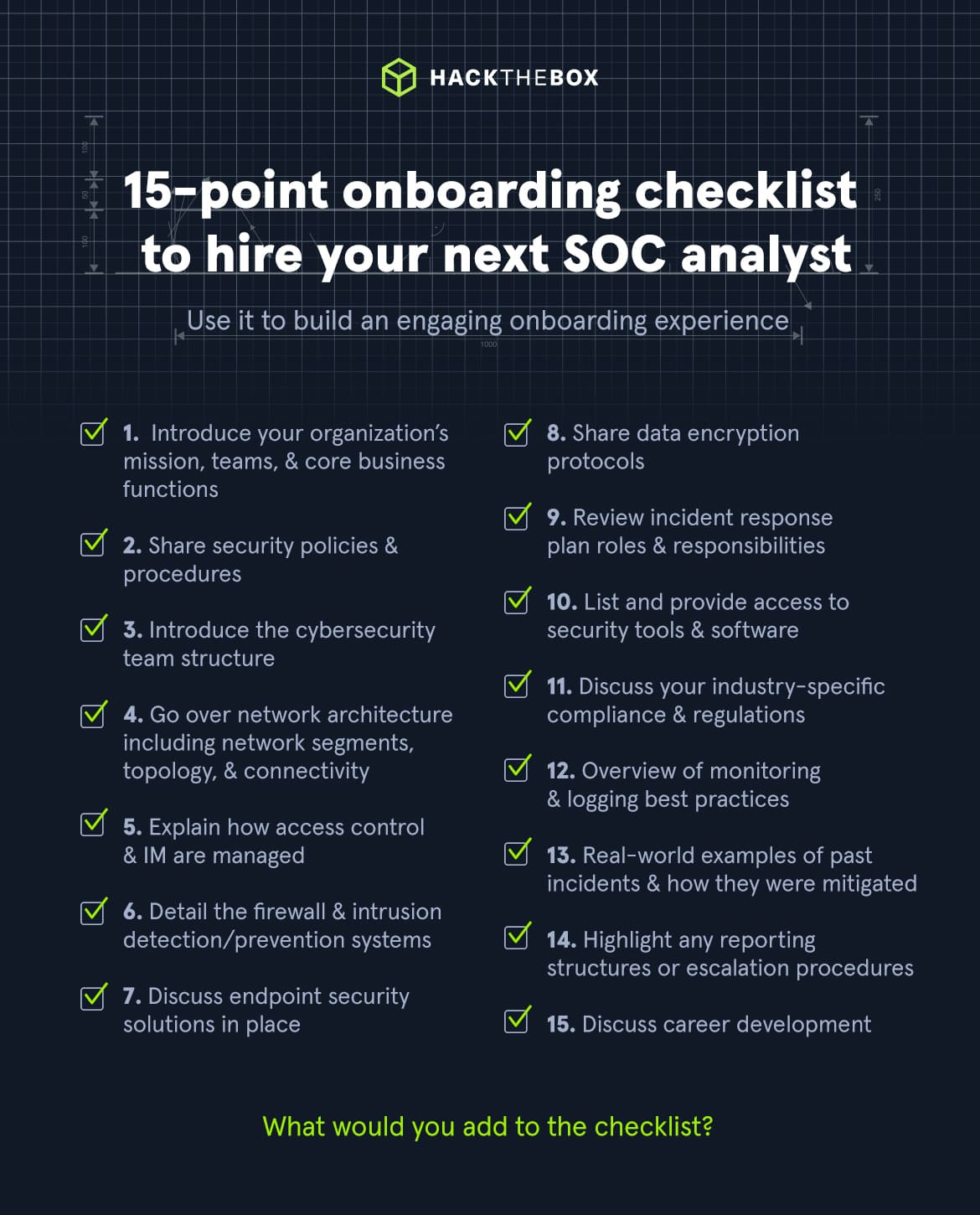
1. Conduct a technology induction
A working knowledge of cybersecurity tools and technologies is a critical first step in onboarding.
One of the first stages of the onboarding process should be to provide an inventory of IT products and services in use. However, it’s vital to go one layer deeper and provide insights into the role of IT in an organization and how the cybersecurity team contributes to its success.
2. Share security processes
Every cybersecurity team will have a strategy and processes to ensure they succeed in their roles. It’s key that new hires become quickly familiar with these:
-
Objectives: what’s a realistic security posture, and how is success or failure measured? This includes the roles and responsibilities of different team members.
-
Risk factors: based on your organization’s unique structure and risk tolerance, new hires must be aware of the biggest risks to existing infrastructure.
-
Threats: even if not pertinent to an individual’s role, all cybersecurity team members should know where and how to access threat intelligence.
-
Compliance: depending on your industry, your cybersecurity team will adhere to different compliance regulations. All new hires should know what these are.
One key benefit of new hires is their unique perspective on existing processes. With fresh eyes come new ideas and ways of thinking.
You should welcome any feedback on your current security strategy as it offers an opportunity to improve processes for future new hires. Consider making feedback a part of your onboarding process with surveys and regular catch-ups.
3. Introduce the cybersecurity team and best practices
A common aspect of any onboarding process is meeting the wider team and setting up inductions. New cybersecurity hires should meet the team and learn about their roles and how they might work together.
This is an excellent opportunity to set up some unique training exercises, such as purple teaming, to help integrate new hires with members of the team they may not always work with.
Some general best practices for onboarding new team members include:
-
Security processes such as checklists and general procedures.
-
Incident response and event management documentation to help new hires understand their role in the event of a breach.
-
The roles and responsibilities of third-party technology.
4. Assess new hires
Before developing an in-depth onboarding upskilling program, it’s important to assess and measure the strengths and weaknesses of new hires.
Easi, a Hack The Box client, used our Professional Labs to assess the skills of new hires, refine the onboarding process, and plan the development of new employees.
Being able to invite new starters is a great feature. It allows us to more accurately measure a new hire's knowledge and how to build upon it.
Mickey De Beats, Red Team CyberSecurity Consultant, Easi.
Read more about Easi’s experience using HTB to assess and onboard new hires here.
By measuring skills early on, you’re able to provide new hires with a valuable onboarding experience that quickly gets them up to speed. Offering the ability to upskill right away is more likely to retain and develop talented cybersecurity professionals.
5. Create a training program tailored to industry frameworks
After assessing the skills of new hires, the next step is to create a tailored training program centered around their particular job role.
Traditionally, cybersecurity training lacks personalization and relevance to industry job roles and trends, such as the latest CVEs.
Industry frameworks to map skills include:
-
MITRE ATT&CK.
-
MITRE DEFEND.
-
NIST/NICE.
-
The DoD Cyber Workforce Framework (DCWF).
At Hack The Box, managers can use the Enterprise Platform to easily search courses using terminology from these frameworks and assign them based on the techniques and tactics relevant to their teams.
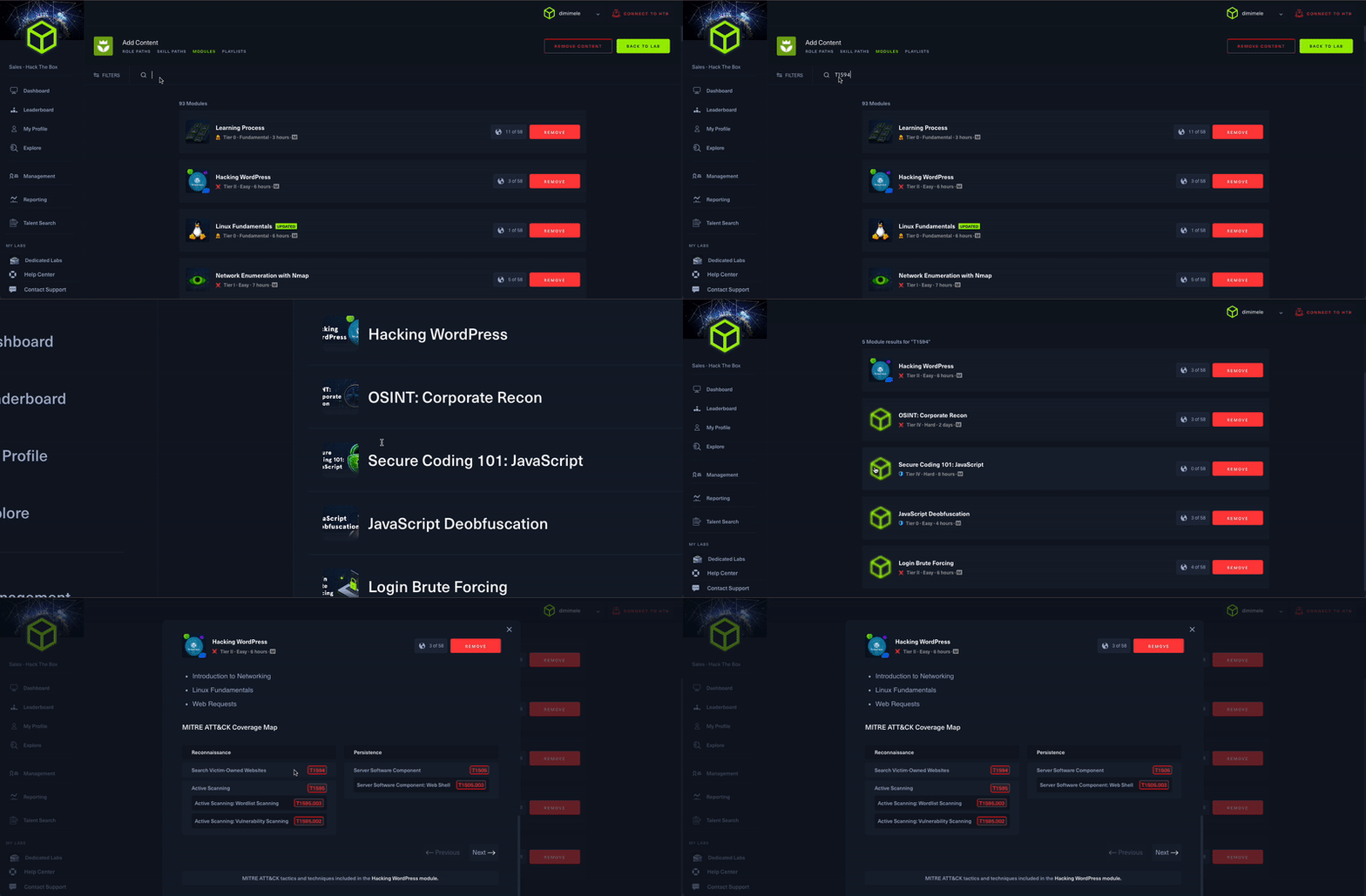
Making your training specific to these industry frameworks is more relevant to real-world scenarios and will ultimately drive new hires to be much better at their jobs.
No two new hires are the same, so being able to personalize skills development will boost retention, as you’ll be providing continuous value and feedback to your team.
6. Benchmark learning with CTFs
A great cybersecurity onboarding process has measurements in place to track the success and development of an employee. Onboarding data and metrics are essential for the C-suite to follow, helping CISOs drive an overall cybersecurity culture shift.
Capture The Flag (CTF) events are a fun and efficient way to benchmark an employee’s learning while offering new opportunities to upskill.
In our Cyber Attack Readiness Report 2023, we interviewed 803 active
cybersecurity professionals and found that:
-
More than 70% of managers view team events like CTFs as a viable way to boost employee engagement.
-
72% of managers agree that CTF events can help measure and upskill employees.
By making CTFs a regular part of your onboarding and upskilling programs, employees will gain great value. Especially when working with team members they may only sometimes interact with.
Prioritize onboarding and mitigate risk
By taking the time to formulate and execute a strong onboarding program, you’ll not only be engaging and retaining new hires but also managing risk. After all, if employees aren’t brought up to speed quickly, you’ll rapidly compromise your organization’s security posture.
Allow your employees to see a future with you by providing an onboarding program that challenges them and reflects your unique culture. This way, you’ll retain top-quality talent and build an elite cybersecurity team.
|
Dan Magnotta (Mags22), HTB Federal Business Development & Capture Manager, Hack The Box Dan Magnotta is an accomplished professional in cybersecurity and intelligence operations with more than a decade of experience in the military and private sectors. His career began with dedicated service to the U.S Department of Defense, where he played critical roles in the U.S. European Command and U.S. Special Operations Command Europe, contributing significantly to cutting-edge cyber strategies. In addition to his civilian role, he serves as an LCDR in the U.S. Navy Reserve, showcasing his leadership and dedication as an Executive Officer for a Navy Reserve Unit. His expertise in cybersecurity, operational analysis, and strategic planning is extensive. At Hack The Box, he tailors solutions to meet the unique requirements of government agencies and organizations worldwide, leveraging his deep understanding of both military and civilian cybersecurity needs. |