Enterprise Wi-Fi: The most trusted attack surface you’re NOT testing (and how to fix that)
Enterprise Wi-Fi is a high-risk but under-tested attack surface. Learn how modern wireless attacks work and how HTB CWPE builds real-world Wi-Fi pentesting skills.


Some security teams out there like to believe that the perimeter is gone. That everything important lives tucked behind identity controls, conditional access, and layers of cloud-native defense. The assumption is that if credentials are protected and endpoints are hardened, the rest will follow.
Wireless networks don’t necessarily agree.
Enterprise Wi-Fi still operates on inherited trust. Devices reconnect automatically. Network names are reused for convenience. Authentication happens before most controls even engage. In practice, this means an attacker doesn’t need to breach your environment to become part of it. They just need to be close enough.
This quiet disconnect between how Wi-Fi is trusted and how it’s attacked is exactly why wireless compromise remains one of the quickest paths from outside lurker to internal access.
Time to get into the details.
TL;DR
-
Enterprise Wi-Fi is one of the most under-tested, over-trusted attack surfaces in modern organizations.
-
Despite heavy investment in cloud security, endpoints, and zero trust, attackers can still compromise credentials, bypass VPNs, and gain internal footholds from parking lots using fast, automated wireless attacks.
-
As hybrid work, guest networks, and WPA3 adoption increase complexity, Wi-Fi pentesting has become a critical security capability.
-
The HTB CWPE certification equips security teams with hands-on, real-world skills to expose and fix wireless weaknesses before attackers exploit them.
Table of Contents
- TL;DR
- The awkward truth about your organization’s Wi-Fi
- How parking-lot attacks exploit enterprise Wi-Fi networks
- Real-world Wi-Fi compromises escalate fast
- Why Wi-Fi pentesting skills matter more than ever
- Introducing HTB CWPE: Certified Wi-Fi Penetration Expert
- Cyber skills training that speaks attacker and defender
- The takeaway for security leaders
The awkward truth about your organization’s Wi-Fi
Most security programs treat Wi-Fi like plumbing. Installed once, assumed safe forever, and only noticed when something floods.
Meanwhile, attackers are absolutely loving it. Unlike cloud services or endpoints, enterprise wireless networks often sit outside regular testing cycles. They’re lightly monitored, rarely challenged offensively, and trusted by default.
But they offer something attackers crave: external access with internal impact. No phishing campaign. No malware delivery. Just a laptop, a radio, and patience measured in minutes.
So in a world where organizations obsess over identity and zero trust, Wi-Fi seems to persist as something of a soft underbelly. It’s the one place where proximity still beats privilege.
How parking-lot attacks exploit enterprise Wi-Fi networks
Modern Wi-Fi attacks are lightning-fast, automated, and startlingly effective. Attackers don’t need to waltz into your building or compromise one single endpoint. From a public space, they can:
-
Deploy an Evil Twin access point mimicking your corporate SSID
-
Trigger deauthentication attacks, and wait for devices to reconnect automatically.
-
Users see a familiar network name, and they don’t question it
-
Their device does the rest
From this point on, credential harvesting becomes trivial. Captive portals that look identical to enterprise login pages intercept usernames and passwords before any perimeter controls wake up. VPNs are as useful as an umbrella in a typhoon if credentials are lifted pre-authentication.
Oh, and MFA won’t help if session tokens have been hijacked. In short: zero trust doesn’t help if trust is already dissolved at the wireless layer.
Real-world Wi-Fi compromises escalate fast
Wireless attacks rarely stay “wireless.” In multiple red-team exercises and real incidents, the pattern is more or less the same:
-
A fake SSID appears
-
A laptop or phone connects automatically
-
Credentials are captured
-
Those credentials unlock email
-
Email unlocks VPN
-
VPN unlocks internal services
And out of nowhere, a threat actor who never crossed your front door is sitting inside your environment, indistinguishable from a legitimate user.

For example: recent research on wireless shows that fundamental design flaws in the IEEE 802.11 Wi-Fi standard let attackers spoof SSIDs and trick devices into connecting to malicious networks, even on WPA3 and enterprise setups—a vulnerability tracked as CVE-2023-52424 that can also disable some VPN protections.
Authentication bypass flaws in common Wi-Fi supplicants have exposed both home and enterprise networks. Router and firmware vulnerabilities continue to turn access points into silent accomplices.
The true cost of a Wi-Fi based breach
Wi-Fi breaches cause serious, measurable damage, so let’s take a closer look at the real-world numbers attached with this kind of attack. According to IBM’s Cost of a Data Breach Report 2025, average breach costs a staggering $4.45 million.
On top of that, incidents involving insecure wireless networks often bump those numbers up, partly due to longer detection times and lateral movement inside networks. So getting your wireless situation locked down should be a non-negotiable.
Let’s dust off the 2007 TJX breach as a first example. Here, attackers took advantage of weak Wi-Fi security to pilfer data from over 45 million credit and debit cards. The cost to the company? An eye-watering $256 million in combined expenses, including everything from fines to legal settlements and remediation.
More recently, a 2024 near-neighbor Wi-Fi attack saw threat actors bypass VPN and MFA protections, gaining internal access to a US firm’s network. While the full financial impact remains undisclosed, similar lateral movement breaches tend to rack up tens of millions in costs due to lost business, incident response, and regulatory penalties.
Additionally, the average cost per stolen record in a breach is $180, meaning that even breaches involving a few million records can balloon into the hundreds of millions in losses. Given that Wi-Fi attacks often serve as the initial access vector for large-scale breaches, ignoring wireless security risks can be incredibly costly.
Complexity is the enemy of security
Enterprise Wi-Fi environments have become messy, to say the least. Things like hybrid work, guest networks, shared credentials, BYOD, legacy configurations, and phased WPA3 rollouts have all played a part, creating sprawling wireless estates that few teams can fully understand.
The thing is this—while security teams may know how Wi-Fi is supposed to work, attackers are thinking about how it actually works. Auto-connect behavior, trusted SSIDs, and human pattern-matching do the rest:
-
Users connect because the network name looks right
-
Devices comply because they’ve connected before
-
Controls that assume a clean perimeter never engage
Without regular offensive testing, these conditions persist unnoticed. The result is a false sense of security built on assumptions rather than evidence.
Why Wi-Fi pentesting skills matter more than ever
Wireless pentesting has lagged behind other security disciplines, not because it’s less important, but because it’s been harder to practice safely and realistically. Traditional training often requires specialized hardware, home lab setups, or outdated scenarios focused solely on WPA2.
That gap is no longer acceptable. As organizations transition to WPA3 and modern authentication methods, security teams need to understand how attackers adapt. What still breaks. What still leaks. And where trust is silently misplaced.
Wi-Fi pentesting isn’t about learning tricks. It’s about understanding how wireless fits into the broader attack chain, and how quickly a “minor” misconfiguration can become a business-level incident.
Introducing HTB CWPE: Certified Wi-Fi Penetration Expert
HTB CWPE doesn’t just teach how these attacks work; it teaches why they matter.
It delivers a practical, hands-on specialization focused on modern enterprise Wi-Fi attacks, not theory or legacy scenarios. You’ll be able to practice real techniques used in real-world environments, from capturing handshakes and deploying Evil Twins to exploiting misconfigurations and understanding how wireless compromise leads to wider enterprise impact.
The cherry on top of this security cake? HTB CWPE does all this without requiring users to buy hardware or build their own labs. Everything runs in Hack The Box’s cloud-based environment, making advanced wireless training accessible, repeatable, and safe. That’s a promise.
Cyber skills training that speaks attacker and defender
What makes HTB CWPE different comes down to scope. It’s not a collection of isolated tricks. It’s a job-role-focused path that builds a holistic wireless skill set.
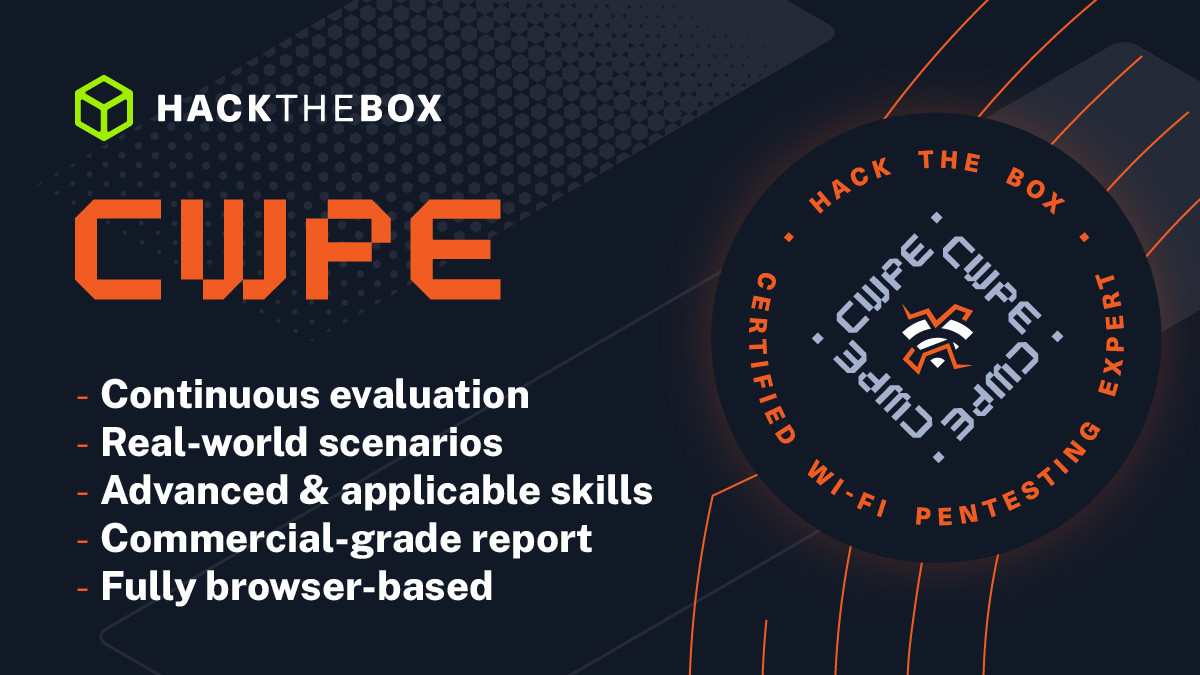
Offensive teams gain the ability to demonstrate real risk during assessments. Network and security engineers learn how attackers abuse configuration decisions. Blue teams gain context to recognize wireless indicators of compromise that would otherwise blend into noise.
This is training designed for modern enterprises, where insider threats, espionage, and physical perimeter bypass are real concerns, not academic ones.
The takeaway for security leaders
If your organization has invested heavily in cloud security, endpoint protection, and identity controls but hasn’t seriously tested Wi-Fi, you’re protecting the castle and leaving the side door unlocked.
Enterprise Wi-Fi is no longer a niche concern. It’s a primary attack surface with a low barrier to entry and high potential impact.
The HTB CWPE certification gives teams the skills to expose wireless weaknesses before attackers do. In today’s threat landscape, that’s not optional. It’s overdue.